Introduction
Residence card (with the annotation: “family member of an EU citizen, Article 10 of Directive 2004/38/EC”) confirms that a family member of an EU citizen (who is not an EU citizen), as well as a family member of a citizen of Iceland, Liechtenstein, Norway, or Switzerland, has the right to reside in Poland for more than 3 months.
This document also:
- confirms the identity and citizenship of the foreign national during their stay in Poland;
- entitles the holder to cross the Polish border multiple times without the need to obtain a visa or meet the entry requirements for visa-free travel, upon presentation of a valid travel document;
- entitles the holder to travel within the Schengen Area for a period not exceeding 90 days within any 180-day period, provided they meet the entry and short-term stay requirements in another Schengen country;
- confirms the holder’s rights arising from the status of a family member of an EU citizen.
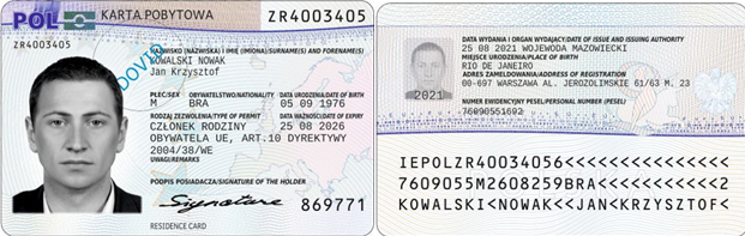
Sample residence card (with the annotation: “family member of an EU citizen, Article 10 of Directive 2004/38/EC”):
|
Eligible persons
- third-country nationals and stateless persons who, within the meaning of the Entry Act, are family members of EU citizens exercising the right to free movement of persons within the EU in Poland;
Issuing authority
- the provincial governor competent for the place of residence of:
- an EU citizen whom the family member is joining or with whom they are residing in Poland;
- the family member of the EU citizen—in cases where the residence card is issued to a family member who has retained the right of residence despite not residing with the EU citizen.
No fee is charged
- is not charged
Waiting period for the document
- up to 6 months
Validity period of the card
- 5 years or less (in accordance with the duration of the EU citizen’s intended stay in Poland, which is less than 5 years).
Issuance of the first document
|
The issuance of a residence card constitutes the final stage of the procedure confirming the right of residence in Poland for a family member of an EU citizen who is not an EU citizen themselves. This procedure involves verifying whether the EU citizen whom the family member is joining or with whom they are residing in Poland has the right of residence in accordance with the conditions set forth in Directive 2004/38/EC, to which the family member is also subject. It is initiated upon application by a third-country national or stateless person and concludes either with the issuance of a residence card or with an administrative decision denying its issuance. Information about the procedure: click the link. |
The provincial governor will notify you that the residence card is ready for pickup, in accordance with standard notification practices (e.g., via text message, email, or a message sent through the application processing system). The notification will include instructions on how to pick up the document.
You will need to appear in person at the provincial office to collect it. The document will be issued to you upon presentation of a valid travel document.
If the residence card is issued to a minor under the age of 13, it is collected by their legal representative or guardian, and in the case of an incapacitated person—by their caregiver—upon presentation of an identity document and in their presence (provided the foreign national is at least 6 years old).
In exceptional circumstances, if you are unable to come to the office due to illness or disability, a representative may collect the document on your behalf. In addition to the appropriate identification document, the representative will also need to present a specific power of attorney authorizing the collection of the residence card and a current medical certificate issued by a specialist confirming the inability to appear in person to collect the document.
Issuance of a new document
Apply to the provincial governor for a new residence card if your current one is about to expire.
To obtain a new document, submit a completed and signed application using the special form to the provincial office corresponding to your current place of residence. Do this in person at least 30 days before your current document expires, and during your visit to the office, present your travel document and provide your fingerprints. Submit the application along with two recent biometric photographs.
Application form - click the link.
|
⇒ An application concerning:
⇒ The presence of a child under 6 years of age is not required when submitting the application. Fingerprints are also not taken from the child. ⇒ In justified cases, including due to health reasons, the provincial governor may allow the application to be submitted without the applicant’s personal appearance. |
The same rules apply to the collection of the document as those applicable to the collection of a document issued for the first time.
Replacement of a document
Circumstances under which a document must be replaced
- changes to the information contained in the document;
- damage;
- loss;
- a change in facial appearance significant enough to hinder or prevent the identification of the foreign national based on the document.
Document replacement procedure
Submit an application for replacement of the certificate within 14 days of the occurrence of any of the above-mentioned grounds for replacement, using the special form.
Application form - click the link.
When submitting the application, follow the same procedure as if you were applying for a new residence card.
Supplementary information
How to proceed in such a situation?
Notify the provincial governor who issued the document to you of the loss or damage to your residence card.Report the loss or damage to the document on the form within 3 days.
Application form -open link.
 |
Failure to notify the loss of a residence card constitutes an offence (Article 81(4) of the Entry Act). |
How do I get the document back?
To this endapply for a replacement document.In support of your request for replacement, tick the box as appropriate: "Loss of document" or "Damage to document".
Application form -open link.
What next?
- Once you have delivered the notice, you will receive a certificate confirming that you have reported the loss or damage to the document.It will be issued to you free of charge. The certificate will be valid for the period of time you are waiting for the document to be replaced, not more than 2 months.
- If your application is granted, you will be issued with a new document and, if it is refused, the governor will issue an administrative decision.A damaged document must be returned and is invalidated. A lost document shall also be invalidated.
- If you find the lost document, notify the relevant provincial governor within 3 days. If you find the document after it has already been replaced,do not keep the recovered document, but return it immediately to the provincial office that issued it.
In what situation must I return the tocument?
- if you acquire Polish citizenship;
- if a decision was issued on invalidating the residence card;
- if you obtain a permanent residence card.
|
Evading the obligation to return the residence card constitutes a misdemeanor (Art. 81(3) of the Entry Act). |
By what deadline must the tocument be returned?
Return the document immediately, no later than within 14 days from the date on which:
- a tocument confirming acquisition of Polish citizenship will be delivered to you;
- the decision annulling the residence card has become final;
- you have collected the permanent residence card.
To whom should the tocument be returned?
- with the voivode, who issued this tocument.
What next?
When returning the document, you may apply with an application for the issuance of a certificate confirming its return. It is issued free of charge and remains valid for 30 days.
The residence card is cancelled:
- as of the date of reporting her loss or damage;
- as of the date of collection of the new residence card in the case of its replacement due to a change of data or such a significant change in facial appearance that identification would be difficult or even impossible;
- in the case of acquisition of Polish citizenship, after the expiry of the return deadline;
- z dniem uzyskania informacji o zgodnie posiadacza tokumentu;
- after the deadline for the return of the tocument following the issuance of the decision to annul the residence card.
If you found someone else's residence card, transfer it immediately to:
- with the voivode;
- to the voivodeship Afterlice commander;
- to the district Afterlice commander;
- to the commander of the Afterlice station;
- to another public administration body - in the country, or to the consul of the Republic of Poland - abroad.
If you retain the tocument, you will commit a criminal offence. Misappropriation of a document is punishable by a fine, restriction of liberty or imprisonment for up to 2 years (Art. 275 of the Penal Code).
Aftertobnym karom podlega osoba, which destroys, damages, renders useless, conceals or removes a tocument, which he/she has no exclusive right to dispose of (art. 276 of the Penal Code).
If during a border check or a check on the legality of residence you present the residence card that you were obliged to return, that tocument will be retained. In its place you will receive a free certificate confirming its retention.
The tocument will then be forwarded to the voivode who issued it for its cancellation.
Both the misappropriation and use of another person's residence card is a crime that is subject to a fine, restriction of liberty or deprivation of liberty for up to 2 years.
